How much of your turnover comes from your biggest customer?
For some construction businesses, the answer could be 40% or more. A long relationship with a reliable main contractor can provide years of consistent work, but it can also create a dependency that becomes difficult to manage when circumstances change.
New figures from Red Flag Alert put that risk into perspective.
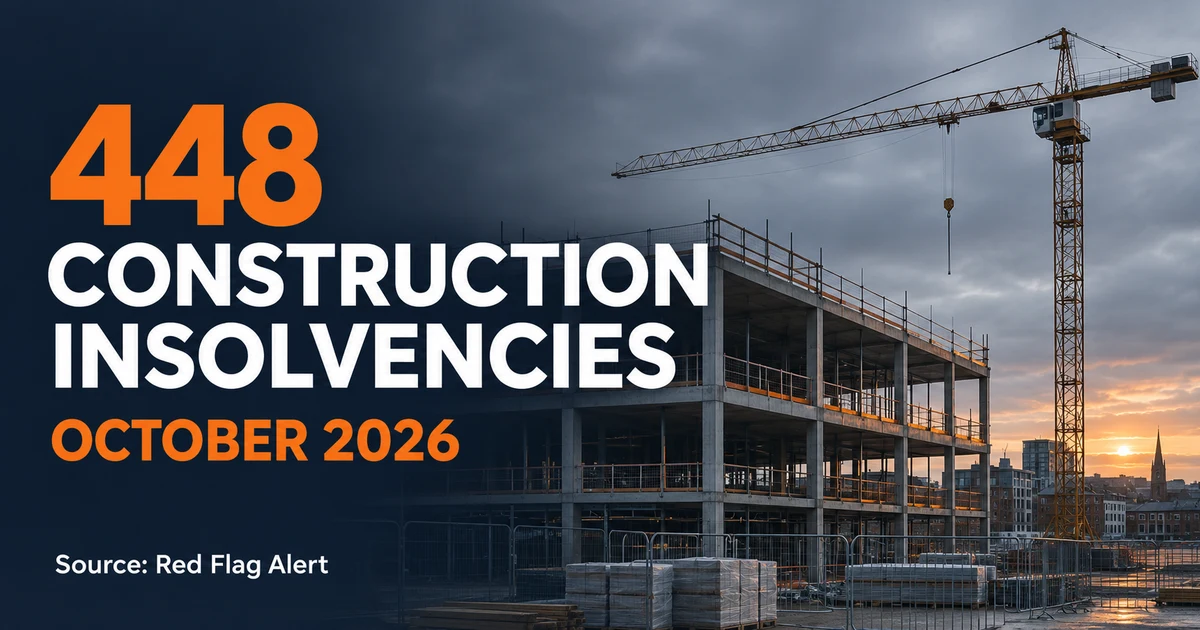
According to its latest report, 448 construction businesses became insolvent in October 2026, the highest monthly figure recorded over the preceding 12 months.
The increase was partly seasonal. Red Flag Alert notes that October and November are regularly among the worst months for construction insolvencies. Nevertheless, October's total exceeded its forecast.
The figures raise an important question for construction directors: how resilient is your business if a major customer stops providing work?
What do the October 2026 construction insolvency figures show?
Red Flag Alert published its October construction insolvency analysis on 17 November 2026, reporting 448 business failures.
The official Insolvency Service figures provide further context. In the 12 months ending October 2026, construction accounted for 3,800 company insolvencies in England and Wales, representing 17% of insolvencies where an industry was recorded.
Construction had the highest number of insolvencies of any industry over that period.
However, the annual total was 5% lower than the preceding 12 months. This matters because October's monthly increase should not be interpreted as evidence that insolvencies are rising continuously throughout the sector.
The two sources also use different reporting approaches and geographical coverage. Their figures should be considered separately rather than combined.
What remains clear is that financial pressure continues to affect a substantial number of construction businesses.
For subcontractors in particular, the consequences can extend beyond the company entering insolvency. Unpaid applications, outstanding retention money and disrupted projects can create problems for other businesses in the supply chain.
Sources: Red Flag Alert, monthly UK construction insolvency data and analysis and The Insolvency Service, Company Insolvency Statistics: October 2026.
Why a full order book doesn't guarantee financial security
A contractor can have several months of work secured and still experience serious cashflow difficulties.
Consider a specialist subcontractor employing 15 people.
The business has enough confirmed work to keep its teams occupied for the next six months. Its largest customer, a main contractor, accounts for 45% of annual turnover.
Then a payment expected at the end of the month is delayed.
The subcontractor still needs to pay its workforce. Meanwhile, another project requires materials to be purchased before the next payment arrives.
The order book looks healthy, but the business has less available cash than expected.
This is a hypothetical example, although the underlying problem will be familiar to many construction companies.
Revenue, profit and cash availability are different measures. A business can be profitable on paper while struggling to meet its immediate obligations.
The position becomes particularly difficult when a significant proportion of expected income depends on one organisation.
Customer concentration is a risk construction businesses can overlook
Customer concentration describes how much of a company's revenue comes from a relatively small number of customers.
For construction contractors, it can develop naturally.
A subcontractor completes a successful project for a main contractor. Another opportunity follows, and over time the relationship becomes an important source of regular work.
There are obvious commercial benefits to this arrangement.
The subcontractor understands the customer's expectations, while the main contractor already knows the quality of its work. Repeat projects may require less time spent pursuing new opportunities.
However, there is a point at which a successful relationship can become a significant financial dependency.
If one customer accounts for half of annual turnover, that customer's decisions can have an enormous effect on the subcontractor's future.
The risk is particularly apparent when the main contractor encounters financial difficulties itself.
How much customer concentration is too much?
There is no universal percentage at which customer concentration becomes unacceptable.
The answer depends on the contractor's financial reserves, the predictability of its work and how quickly it could replace lost revenue.
Nevertheless, every construction business should understand its exposure.
Start by calculating the percentage of turnover generated by your largest customer over the previous 12 months.
Then consider what would happen if that customer stopped awarding new work.
Would existing projects provide enough time to find alternatives? Could the business continue meeting its obligations while replacement work was secured?
These questions are worth answering before a problem develops.
Why business development matters when contractors are already busy
One of the most common mistakes in construction business development is waiting until the order book starts looking thin.
When projects are plentiful, finding new customers can seem unnecessary.
Directors are occupied with delivery, and there may be little immediate incentive to spend time developing relationships with other organisations.
But winning work from a new main contractor rarely happens overnight.
A prospective customer might need to understand a subcontractor's capabilities before considering it for a project. The contractor may then need to complete supplier onboarding or wait for a suitable package to become available.
Even when the initial conversation goes well, there is no guarantee of an immediate opportunity.
This creates a problem for businesses that only start looking for work after losing an existing customer.
By that stage, they may need new revenue much sooner than their prospective customers are ready to award contracts.
Business development is most useful when contractors have enough time to be selective about the opportunities they pursue.
It allows them to build a wider customer base without accepting unsuitable work simply to keep their teams occupied.
How construction contractors can reduce their dependence on major customers
Reducing customer concentration does not necessarily mean taking on more projects.
For a business already operating near capacity, the priority may be to develop alternative customer relationships that can support future work.
1. Identify which customers you want to work with
Start with the type of work your business is best equipped to deliver.
A specialist concrete repair contractor, for example, may want to build relationships with main contractors responsible for refurbishment and remedial projects.
A commercial decorating business might focus on contractors delivering education projects or planned maintenance programmes.
The objective is to identify organisations whose requirements genuinely match your capabilities.
This helps avoid spending time pursuing opportunities that are unlikely to be commercially worthwhile.
2. Build relationships before procurement begins
Many construction businesses only approach prospective customers when a tender opportunity becomes available.
By then, the contractor may be competing against suppliers who already have established relationships with the commercial team.
Earlier engagement gives prospective customers time to understand the business.
That could involve introducing relevant project experience, demonstrating technical expertise or discussing the types of work the contractor regularly undertakes.
The initial objective should be to become a credible supplier worth considering.
There may be no immediate project, and that is fine.
3. Use LinkedIn to maintain visibility with relevant decision makers
LinkedIn can support this process, particularly for specialist subcontractors targeting identifiable main contractors.
Construction directors can use their personal profiles to demonstrate experience and discuss the work their businesses undertake.
For example, a contractor specialising in structural waterproofing could share practical observations from completed projects, explaining the challenges encountered and the methods used to address them.
Relevant commercial managers may encounter that content before they have a requirement for those services.
Direct outreach can also help establish contact, provided it is relevant to the recipient's responsibilities.
LinkedIn cannot guarantee new contracts, and visibility alone is insufficient.
Its value comes from supporting relationships that may develop into commercial opportunities over time.
For a more detailed explanation, see our LinkedIn marketing services for construction companies.
More customers will not automatically mean a stronger business
Diversifying the customer base needs to be approached carefully.
Taking on poorly priced work to reduce reliance on an existing customer could introduce different financial problems.
A contractor should consider whether each new opportunity offers an acceptable margin and payment terms that the business can manage.
The financial position of prospective customers also deserves attention.
Replacing one financially vulnerable customer with several others carrying similar risks may provide little additional protection.
Business development should therefore support commercial decision making rather than simply increase the number of enquiries.
For some contractors, maintaining a smaller number of dependable customers may be entirely appropriate, provided the financial exposure is understood and manageable.
What should construction directors take from the October figures?
The 448 construction business failures reported by Red Flag Alert are a reminder of the pressures facing the industry.
They do not tell us that customer concentration caused those insolvencies. Businesses fail for different reasons, and the published figures do not establish the circumstances behind every case.
However, they provide a useful reason to examine the commercial risks within an individual construction business.
A contractor with strong customer relationships and a healthy order book may still be exposed if too much of its income depends on one organisation.
Developing alternative relationships takes time, particularly in construction, where supplier selection and project procurement can involve lengthy processes.
The businesses best placed to manage that risk are those that understand their exposure and begin building options before they urgently need them.
The question for construction directors is straightforward: if your biggest customer stopped awarding work tomorrow, how prepared would your business be?
Building a wider pipeline of construction opportunities
Market Maestro helps UK construction companies build relationships with the main contractors and commercial decision makers they want to work with.
Our approach focuses on founder-led LinkedIn activity, relevant outreach and consistent business development.
If your business relies heavily on repeat work from a small number of customers, we can help you identify and start building relationships with other suitable organisations.
Explore our LinkedIn services or contact Market Maestro.
Sources
- Red Flag Alert: monthly UK construction insolvency data and analysis, October 2026 report published 17 November 2026.
- The Insolvency Service: Company Insolvency Statistics, October 2026, published 17 November 2026.
The Construction Pipeline Brief · Every Monday · 5 minutes
Want the useful construction opportunities without hunting for them?
Every Monday we send the Construction Pipeline Brief: major frameworks, contractor appointments, supply-chain opportunities and one practical LinkedIn idea for construction firms.